On this page
You need a new laptop, so you open 12 tabs. Two hours later, you’ve read 40 reviews, built a comparison table and still haven’t bought anything. That’s analysis paralysis: thinking so hard about a choice that you never actually make it.
It shows up with small choices, too, like which task to start first or which daily planner to try. And it’s tiring, because your energy goes into deciding instead of doing. The good news is that you rarely need more information. You need fewer options, a deadline for the decision and a clear idea of “good enough”. This guide shows you how.
What analysis paralysis is, and why it happens
Analysis paralysis is when weighing your options takes the place of acting on them. You keep gathering facts, comparing and second-guessing, so the decision keeps sliding to later.
For example, it often looks like this:
- You research past the point of usefulness. The tenth review tells you nothing the third one didn’t.
- Every option has a “but”. So none of them feels safe enough to pick.
- Small choices take big energy. Picking which email to answer first feels as heavy as a career move.
- You wait for certainty. You hope one option will finally feel obviously right.
Underneath, it usually comes from a fear of choosing wrong. When a choice feels permanent, every flaw looks huge. As a result, more thinking feels safer than acting, even though it keeps you stuck.
It can be harder with ADHD traits, because weighing options leans on working memory and planning. However, struggling with decisions isn’t a diagnosis. Stress, burnout and anxiety can do the same thing. If indecision gets in the way of daily life, talk to a doctor or psychologist. NIMH has a clear overview of ADHD if you want to learn more.
A good decision made today beats a perfect one made never.
Too many choices: what the research really says
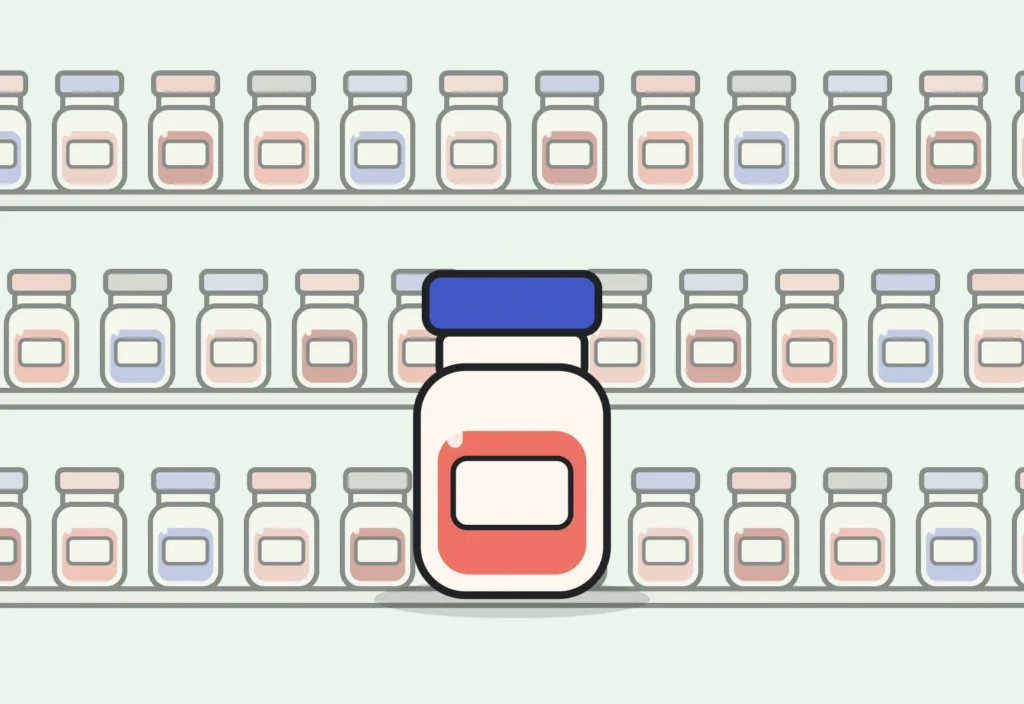
In a well-known study by Iyengar and Lepper (2000), a grocery store tasting booth offered either 24 jams or 6. The big display drew more people: 60% of passersby stopped, compared with 40% at the small one. However, only 3% of the shoppers at the big display bought a jar, while nearly 30% did at the small one.
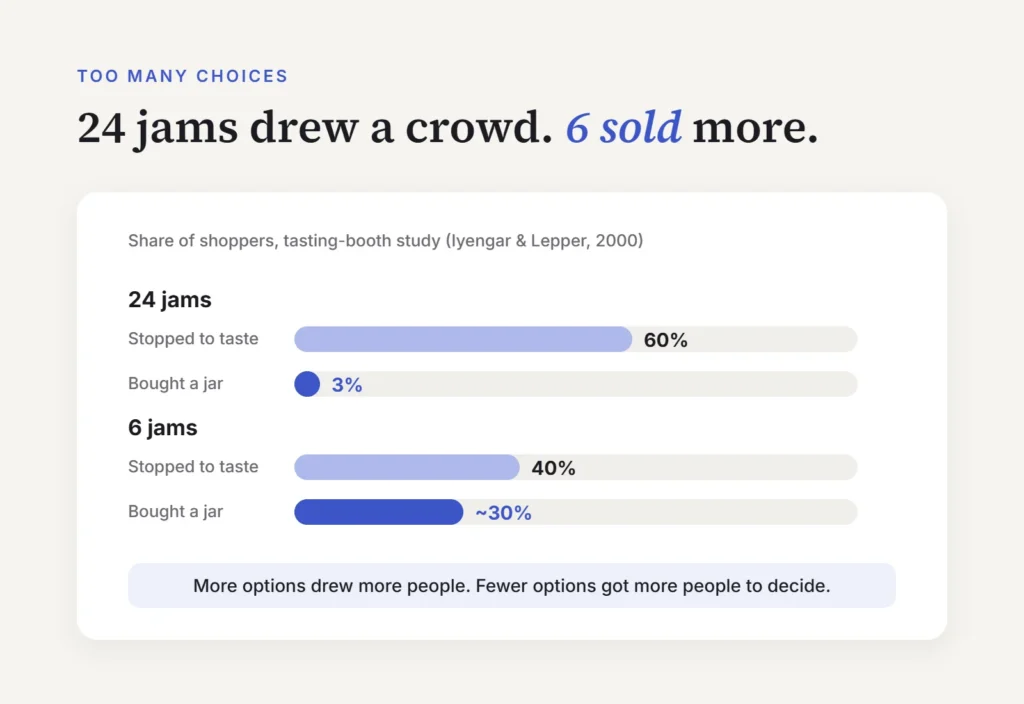
That sounds like proof that too many choices always backfire. But the full picture is more useful. A meta-analysis of 50 experiments with 5,036 participants found that, on average, the effect of more options was close to zero. Some studies showed overload, and others didn’t.
So when does a long list freeze you? A later review of 99 observations pointed to four factors: how complex the options are, how hard the decision task is, how unsure you are about what you prefer, and what your goal is. In other words, choice overload hits hardest when options are hard to compare and you don’t yet know what you want.
That’s good news. You can’t always cut the options. But you can make them easier to compare, and you can get clear on what you want before you start.
Why decision paralysis drains your energy
Decision paralysis isn’t laziness. It’s work that doesn’t look like work. Each time you reopen a choice, you load every option back into your head, compare them again and set them down again.
Meanwhile, the open decision keeps tugging at you. It sits on your to-do list, follows you into other tasks and makes it harder to focus. From the outside, it can look like procrastination. That’s why you can feel worn out at 4pm after a day when you “didn’t do anything”.
- Reopened choices cost twice. You pay for the thinking every time you go back to it.
- Open loops steal focus. An undecided choice keeps pulling attention from the task in front of you.
- Waiting has a price, too. Not choosing is a choice. Deadlines move closer, and good options can disappear.
Decision paralysis also spreads. One open choice, like which project to start, can block everything behind it on your list. In other words, a single stuck decision can quietly stall a whole week.
So the goal isn’t to think less carefully. It’s to think once, on purpose, and then close the loop.
7 ways to stop analysis paralysis
These steps work for big and small decisions. Start with the one that fits the choice in front of you.
- Name the real question. Write it as one line, such as “Which laptop under $900 is best for travel?” Vague questions invite endless research.
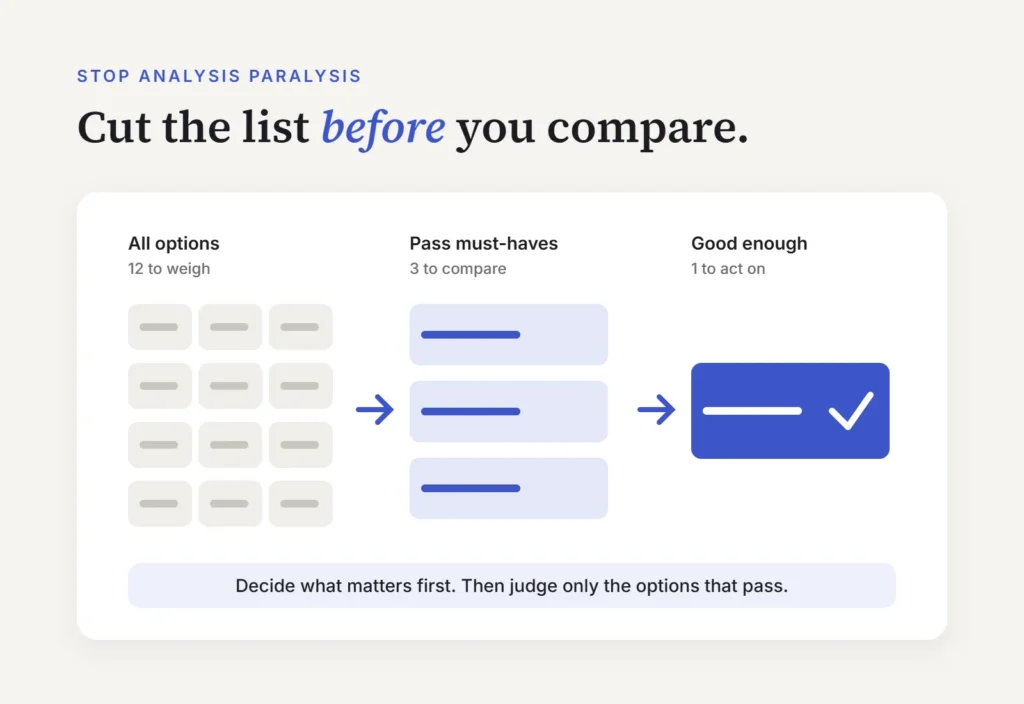
- Pick your top 3 criteria first. Decide what matters before you look at options. Then judge each option only on those 3.
- Cut the list to 3. Drop anything that fails a must-have. Comparing 3 options is far easier than comparing 12.
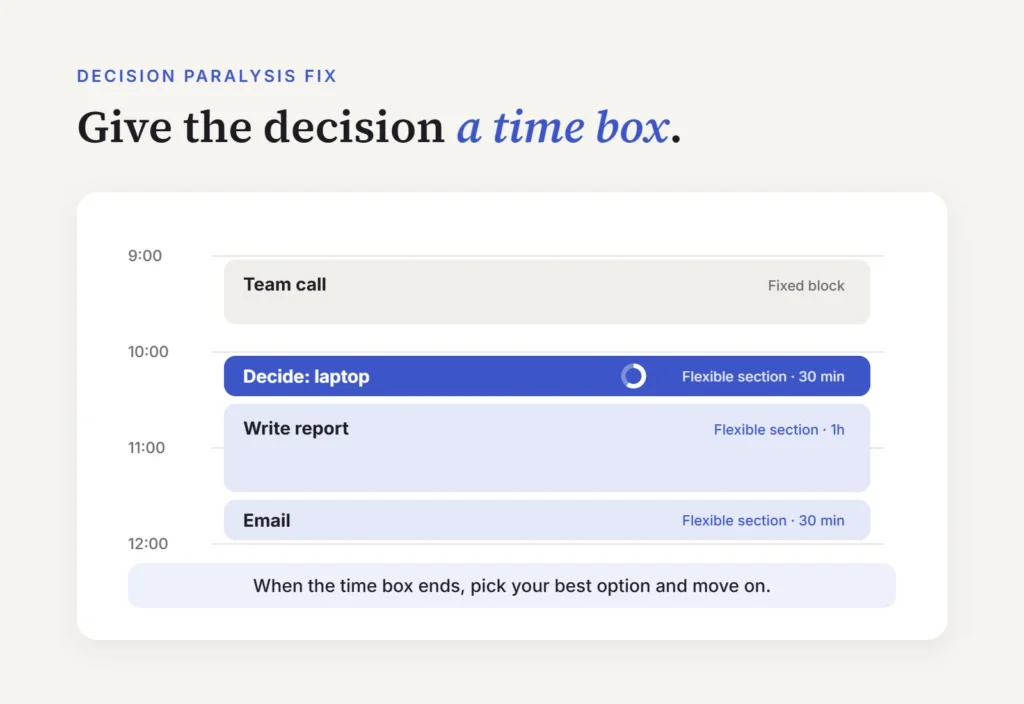
- Set a decision deadline. Give the choice a time box, like 30 min today, and put it in your schedule planner like any other task.
- Define good enough. Ask, “What would make this a fine choice?” The first option that clears that bar wins.
- Ask how reversible it is. Most choices can be undone or adjusted. If it’s reversible, decide fast and learn from the result.
- Take one small action. Order the sample, book the call or write the first line. Action gives you information that thinking can’t.
For example, here’s how the laptop choice could go. Your question is a travel laptop under $900. Your criteria are weight, battery life and price. Three models pass, so you give the choice 30 min. The lightest one with all-day battery wins. You order it, and all 12 tabs can finally close.
Giving a decision its own time box is simply time blocking for choices. It turns “I’ll figure it out later” into a short, planned task with an end.
And if you still freeze at the starting line after you’ve decided, our guide to executive dysfunction and task paralysis has small ways to begin.
How to stop overthinking with a 5-day decision plan
For a bigger choice, such as a job offer, a move or which project to drop, use this plan. Each day takes about 15–20 min. Write each step in your daily planner or notes so you don’t redo it.
- Day 1: Write the question and a deadline. One sentence, plus the date you’ll decide by.
- Day 2: List what matters. Choose 3 criteria and rank them.
- Day 3: Shrink the options. Remove anything that fails a must-have. Keep 3 at most.
- Day 4: Find only the missing facts. Look up what you need to judge your 3 options. Stop when the time box ends.
- Day 5: Decide and take one step. Pick the option that best fits your top criterion, then take one small action within 24h.
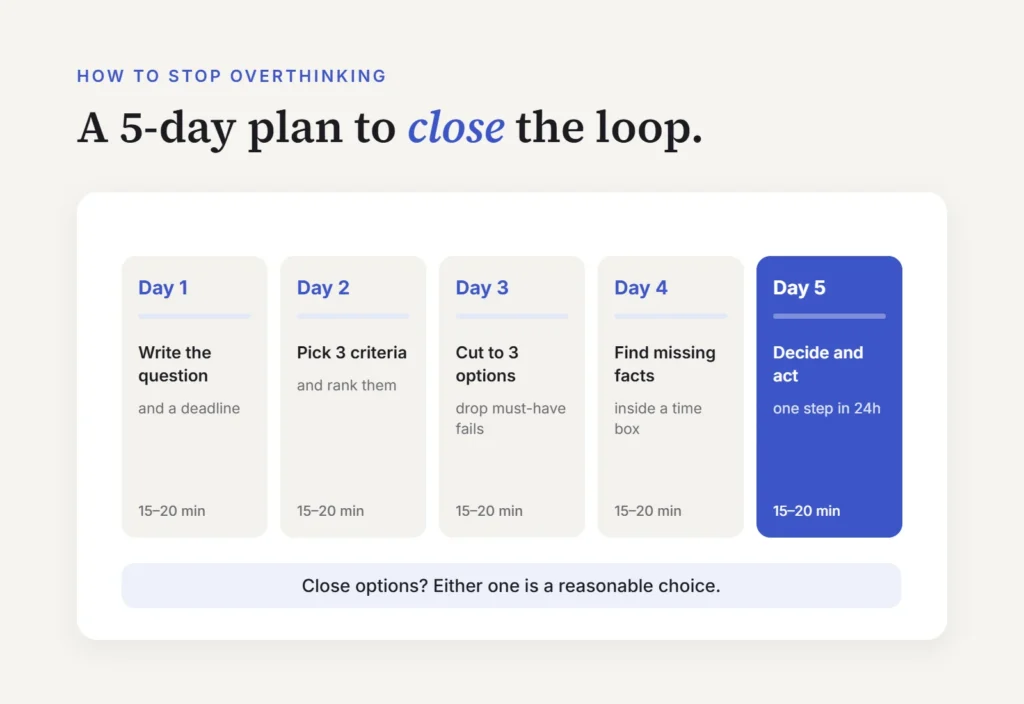
However, if you still feel torn on Day 5, the options are probably close. When options are close, either one is a reasonable choice, so pick one and move on.
Also, write down why you chose it. Later, when doubt shows up, you can reread your reasons instead of reopening the whole decision. That’s one of the simplest ways to stop overthinking a choice you’ve already made. Then, to see the choice through, read how to finish what you start.
Deciding is a skill. It gets easier every time you close a loop.
How Thrive helps when analysis paralysis hits
Thrive is a free schedule planner for iPhone and Android. It won’t make the choice for you. However, it gives decisions a clear place in your day, so they stop floating around your head.
Add a flexible section such as “Decide: laptop” with a 30 min duration. Then use the built-in focus timer to work on just that choice. When the time is up, pick your best option and move on. If the day gets away from you, the flexible section moves forward automatically, so the decision doesn’t get lost.
Live insights help with the other kind of paralysis: too many tasks. “Over Planning” tells you when your plan goes beyond your daily capacity, so you can choose what to move before you freeze. This works well with a flexible schedule that survives a real day, and with fixes for time blindness if your time boxes tend to run long.
Over time, Stats show your Planning vs. Execution, so you can see whether decisions get made when you planned them.
Analysis paralysis isn’t a sign that you’re bad at decisions. Usually it means too many choices and no finish line. So cut the list, set a deadline, define good enough and take one small step. That’s how to stop overthinking and get back to doing.
FAQs
What causes analysis paralysis?
It usually comes from a fear of choosing wrong, plus options that are hard to compare. Stress, tiredness and unclear priorities make it worse, so decision paralysis often hits hardest on busy days.
Is analysis paralysis a sign of ADHD?
Not on its own. Many people get stuck on decisions, and ADHD traits, anxiety or burnout can all make it harder. If indecision affects your daily life, talk to a doctor or psychologist.
Why do too many choices make it harder to decide?
With too many choices, there's more to compare and more ways to feel you chose wrong. Research suggests this matters most when options are complex and you're unsure what you want.
How do I stop overthinking a decision?
Set a deadline, choose 3 criteria and cut your options to 3. Then pick the first option that's good enough and take one small step. That's how to stop overthinking without forcing a perfect answer.