On this page
You walk into the kitchen and stop. Why are you here? Or you’re halfway through an email, a notification pops up, and the sentence you were writing is gone. That’s your working memory dropping something, and it happens to everyone.
For some people, though, it happens all day. You lose track of multi-step instructions, forget what you were doing mid-task and repeat the same mistakes. It can make you feel careless. You’re not. Forgetfulness like this is usually a capacity problem, not a character problem. So the fix isn’t trying harder to remember. It’s needing to remember less.
What working memory is, and why it drops things
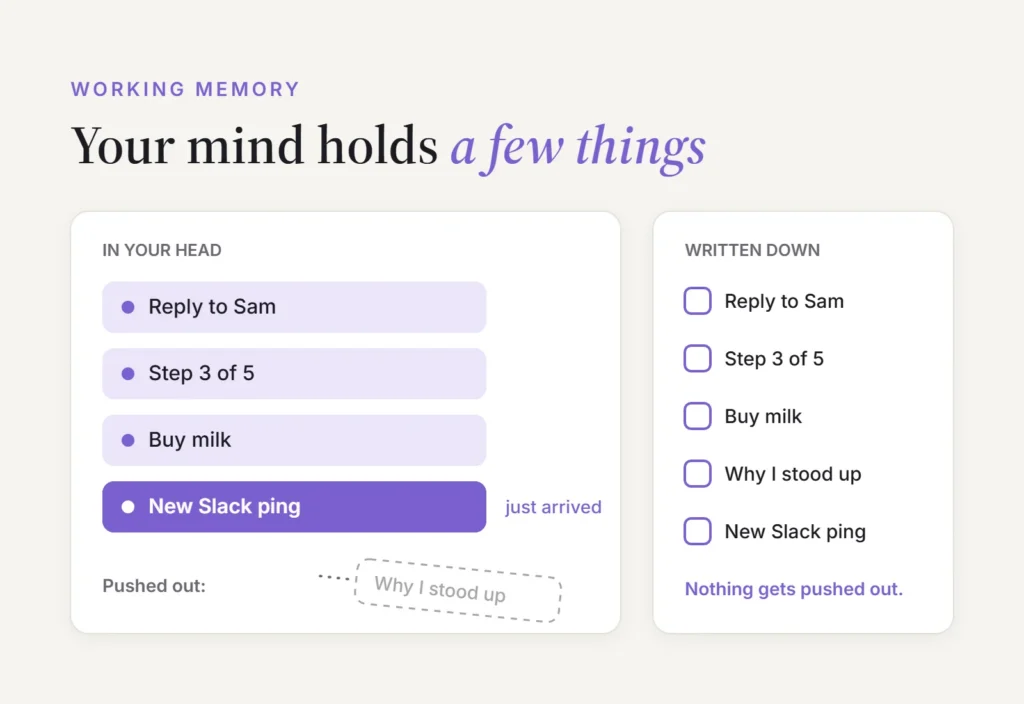
Working memory is your brain’s sticky note. It holds the few things you’re using right now. For example, the next step in a recipe, the number you’re about to type or the reason you stood up.
However, that sticky note is small, and it fades fast. When something new arrives, older items get pushed out. In other words, you didn’t forget because you weren’t paying attention. You forgot because the space was full.
Even a change of scene can clear it. In experiments by Radvansky and colleagues (2011), people remembered objects less well after walking into a new room, even in a real building. Going back to the first room didn’t bring the memory back. So that “why am I here?” moment is a known effect, not a personal failing.
For example, an overloaded memory often looks like this:
- You lose your place mid-task. One interruption, and you can’t find the thread again.
- Multi-step instructions fall apart. You remember step 1 and step 4, but not the middle.
- Things go missing. Keys and chargers end up wherever your hands were when your mind moved on.
- You repeat mistakes. Not because you didn’t learn, but because the lesson wasn’t there when you needed it.
Forgetting an intention is a special case. “Text Mom after lunch” has to survive a whole morning of other thoughts, with nothing to remind you at the right moment. That’s why plans you only keep in your head so often vanish. They need a cue outside you, like a note, a list or a set time in your day.
At work, this might look like forgetting to send the file you promised in a meeting. At school, it might be losing the third step of a lab. Meanwhile, at home, it’s the laundry that sits in the washer overnight. In each case, the plan was fine. It just had nowhere to live except your head.
Working memory and ADHD: what the research shows
Working memory struggles are common with ADHD traits. A meta-analysis of 26 studies found that children with ADHD scored lower than their peers on several kinds of memory tasks. The gaps were largest for spatial tasks, such as keeping track of where things are, and smaller but still clear for verbal ones.
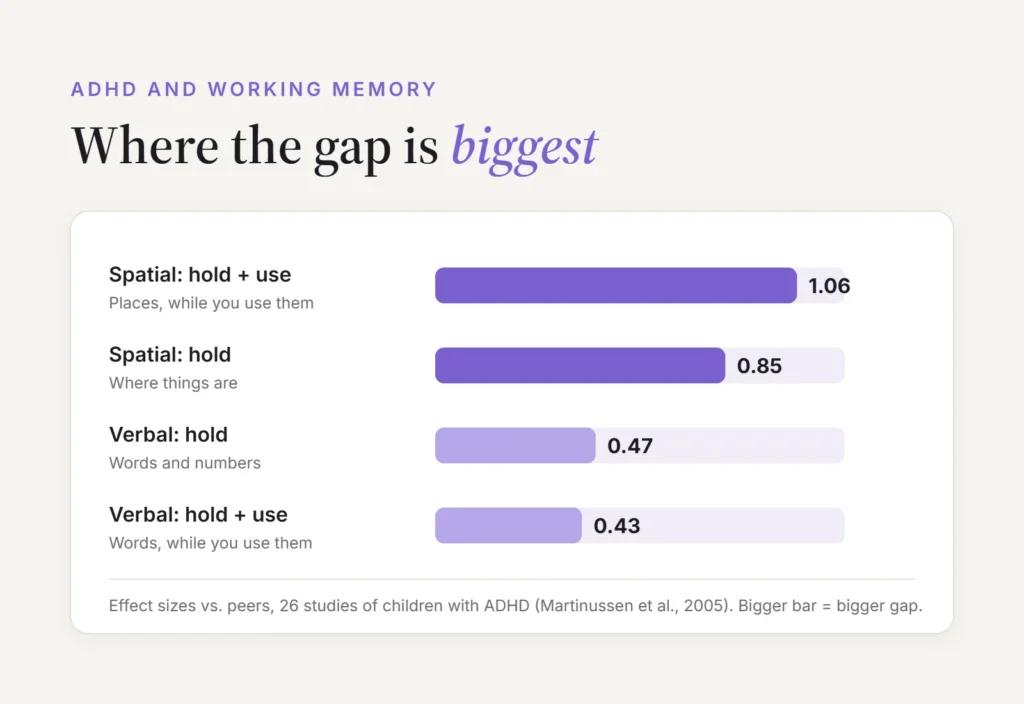
The effect sizes ranged from 0.43 for some verbal tasks to 1.06 for the hardest spatial tasks. In plain terms, it’s a real difference in how the brain holds information, not a lack of willpower. It also tends to travel with time blindness and executive dysfunction, because all three lean on the same mental workspace.
However, forgetfulness isn’t a diagnosis on its own. Stress, poor sleep, anxiety, depression and burnout can all crowd that mental space, too. If forgetting things gets in the way of work, school or relationships, talk to a doctor or psychologist. NIMH has a clear overview of ADHD if you want to learn more.
Forgetting isn’t a flaw in you. It’s a full shelf.
How to improve working memory: what training can and can’t do
It’s tempting to look for a brain-training game that fixes everything. Unfortunately, the evidence is weak. A large meta-analysis of 87 publications found that memory training made people better at tasks like the ones they practiced. However, it didn’t reliably improve reading, math or reasoning.
So how do you improve working memory in daily life? Mostly by protecting it rather than stretching it. For example:
- Sleep and move. Tiredness shrinks your mental bandwidth. A short walk or a good night’s sleep often helps more than an app.
- Cut interruptions. Every notification asks your brain to drop what it’s holding.
- Do one thing at a time. Each switch means reloading everything you were holding before.
- Write it down. Paper, a notes app or a daily planner holds information, so your head doesn’t have to.
In other words, the most reliable way to have a better memory day is to give your memory less to carry. That’s good news. You don’t need a special program, just a few habits that make remembering less necessary.
7 ways to stop forgetfulness from derailing your day
You don’t need all seven. Instead, start with one or two. Each one moves a piece of information out of your head and into the world, where it stays put.
- Capture it within 10 seconds. The moment you think “I need to…”, write it down. A thought you don’t capture is one you’ll have to chase later.
- Say the reason out loud. Before you stand up, say “Getting the charger.” Hearing it gives the thought a second hook.
- Give every item a home. Keys, wallet and headphones live in one spot by the door. Then you don’t have to remember where they are. You just look.
- Leave a breadcrumb before you switch. When an interruption hits, write one line, such as “Next: fix paragraph 2.” Coming back then takes seconds, not minutes.
- Turn instructions into a checklist. If someone gives you 5 steps, write all 5 down before you start. Then tick them off as you go.
- Use if-then plans. “If I close my laptop, then I write tomorrow’s first task.” Linking an intention to a cue makes it easier to recall at the right moment.
- Keep one task on screen. Close the tabs you don’t need. A single visible task is easier to hold than ten half-open ones.
If-then plans have solid backing. Across 94 tests, Gollwitzer and Sheeran (2006) found a medium-to-large effect on reaching goals. Meanwhile, keeping one task on screen also helps with analysis paralysis, because there’s less to weigh at once.
How to beat forgetfulness with a 5-day plan
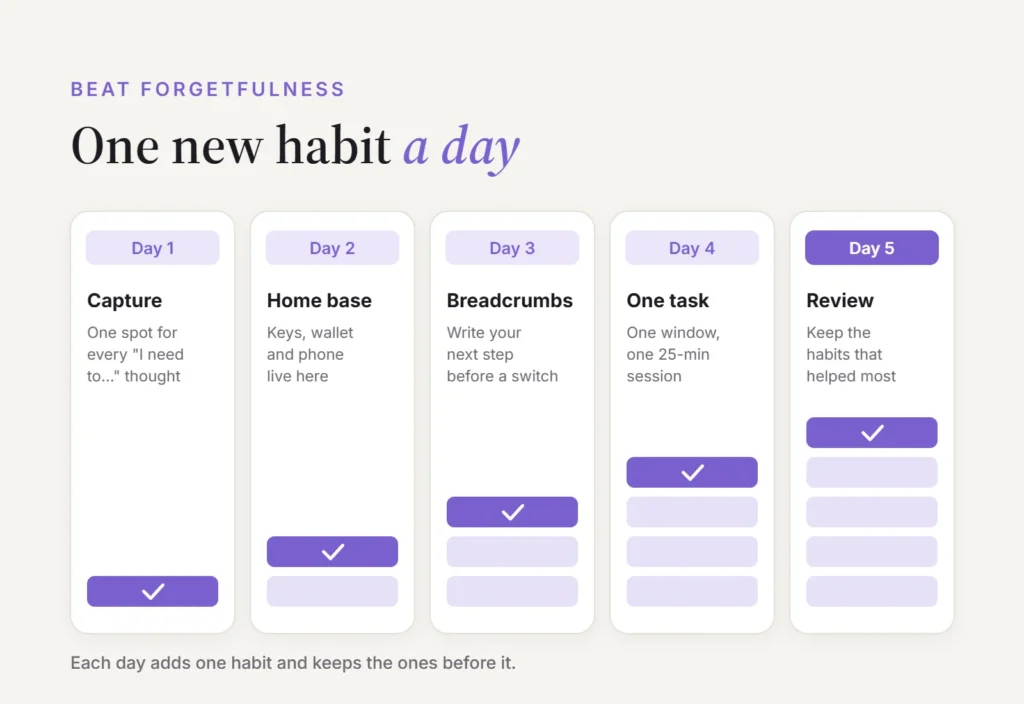
Trying all 7 at once is its own memory load. Instead, add one habit a day and keep the ones that stick.
- Day 1: Capture. Pick one capture spot, like a notebook, a notes app or a to-do list. Use it for every “I need to…” thought.
- Day 2: Home base. Choose one spot for keys, wallet and phone. Put them there every time you walk in.
- Day 3: Breadcrumbs. Each time you’re interrupted, write one line about your next step before you switch.
- Day 4: One task on screen. Work in one window for one 25 min focus session. Keep everything else closed.
- Day 5: Review. Spend 10 min looking back. Which habit saved you the most? Keep it, and add another next week.
Missed a day? That’s fine. Falling behind isn’t failure. It’s information. Pick up with the next habit and keep going. As a result, a week from now you’ll have a few small systems doing the remembering for you.
How Thrive helps when your working memory is full
Thrive is a free schedule planner for iPhone and Android. It’s built to hold the plan, so you don’t have to keep it all in your head.
- A live schedule that keeps track for you. Add fixed blocks for meetings and classes, and flexible sections for work with a planned duration. If you fall behind, flexible sections move forward automatically, so nothing quietly drops off. It’s a flexible schedule that updates itself.
- A focus timer for one task at a time. Start the timer on a section and work on just that. Forgot to start it? Log your progress afterward with the one-swipe progress slider.
- Live insights that do the math. “Free time today” and “Can’t finish plans today” show where you stand, so you don’t have to count hours in your head.
- Areas of life and Goals. Plan time for what matters, like University or Exercise, and see where your time went in your stats.
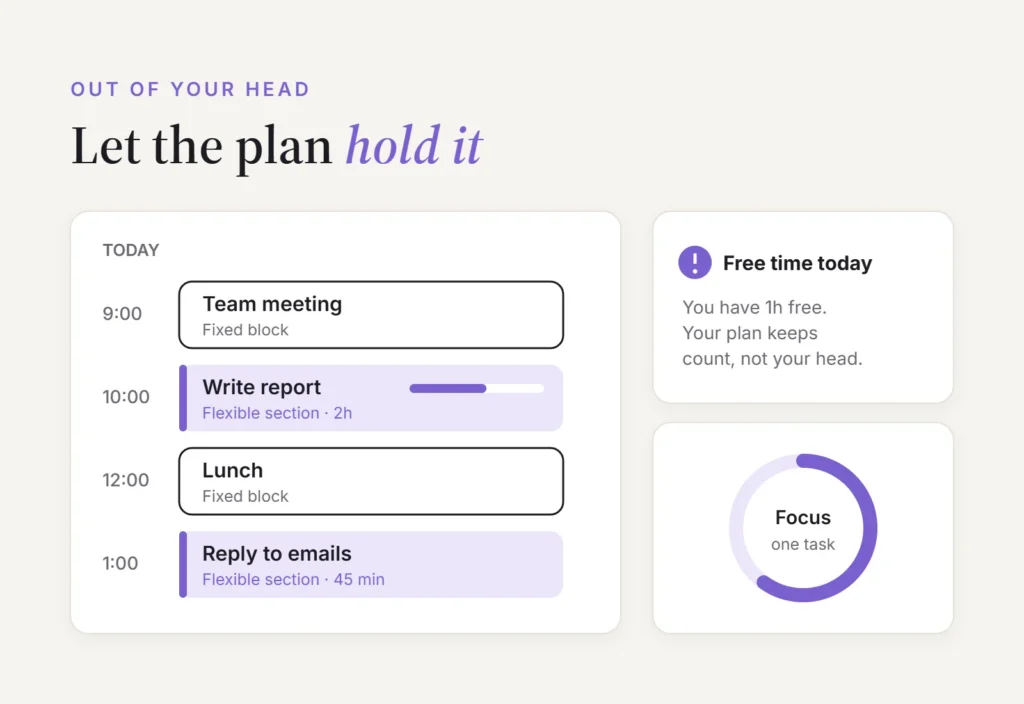
For example, say a meeting runs 30 min over. You don’t have to remember to shift your afternoon. Your flexible sections move forward on their own, and the insights show what still fits. In other words, Thrive becomes the place your plans live. Meanwhile, your head gets to focus on the task in front of you.
Forgetfulness isn’t a sign that you’re careless. Your working memory is small, and it was never meant to hold your whole day. So get things out of your head, protect your focus and rest well. That’s how to improve working memory where it counts: in the middle of a busy, real day.
FAQs
What is working memory?
It's the short-term mental space that holds what you're using right now, like the next step of a task. It holds only a few things and fades quickly, so it's easy to overload.
Is forgetfulness a sign of ADHD?
Not on its own. Working memory ADHD research shows clear differences on average, but stress, poor sleep, anxiety and burnout can cause forgetfulness, too. If it affects daily life, talk to a doctor or psychologist.
Can you improve working memory?
Training games mostly improve the tasks you practice, not everyday skills. The most reliable way to improve working memory in daily life is to sleep well, cut interruptions and write things down.
Why do I forget what I was doing mid-task?
An interruption or a new thought pushes the old one out of working memory. Write a one-line note about your next step before you switch, and it's easy to pick back up.