On this page
You start a new course, side project or plan with real energy. A week or two later it slows, then stops, and joins the pile of half-done projects. If you want to finish what you start, the fix is rarely more willpower.
You’re not lazy, and you’re not broken. Finishing is mostly about planning the part nobody plans: the long, quiet middle.
Why you start projects but never finish them
Starting feels good because everything is new. The idea is fresh, the first steps are obvious, and progress is fast.
However, around the middle, that changes. The novelty wears off, the easy wins are gone, and what’s left is slower, less exciting work. A few things make that stretch harder than it needs to be:
- No clear finish line. “Get fit” or “build the app” never says when you’re done, so done never feels close.
- No next step. You know the goal, but not what to do in the next 30 min, so you do something else.
- Too many projects at once. Every new idea borrows attention from the ones already running.
- Optimistic estimates. Most things take longer than we expect. In a classic study on the planning fallacy, students expected to finish their thesis in about 34 days. On average it took 55, and fewer than a third finished on time. If you’re always late on estimates like these, try these time blindness fixes.
- Perfectionism near the end. The last stretch is where the work becomes real and visible, which can make finishing feel risky.
None of these is a character flaw or a lack of time management skill. They’re design problems, and design problems can be fixed. If your struggle is starting in the first place, our guide to executive dysfunction covers how to start a task when you feel frozen.
When it might be more than a habit. Trouble following through on tasks is one of the patterns associated with ADHD. On its own, it doesn’t mean you have it. But if unfinished work has affected your job, studies or relationships for a long time, it’s worth talking to a doctor or psychologist. The ideas below can help either way. They just don’t replace professional support.
Decide what “done” looks like
A project without a finish line can’t be finished. So, first of all, write one sentence that describes done.
Make it concrete and easy to check:
- Instead of “learn Spanish”, try “finish the 30 lessons in level A1”.
- Instead of “start a blog”, try “publish 4 posts”.
- Instead of “redo the guest room”, try “paint the walls and put up 2 shelves”.
Next, shrink it. Ask yourself: what’s the smallest version that would still count? You can always make a version 2 later. Version 1 just has to exist.
It also helps to write down what done is not. For example, “version 1 doesn’t need a logo” or “the guest room doesn’t need new floors.” Naming what’s out of scope stops the finish line from quietly moving away.
Done is a decision, not a feeling.
How to finish what you start: plan the messy middle
The middle is where projects stall, so that’s where your plan should be strongest. Here’s a simple routine that works for side projects, courses and personal goals alike:
- Break the project into sessions, not tasks. A session is 30–90 min of focused work, ideally with a focus timer running, and one clear outcome, like “draft the intro” or “sand the shelves”.
- Write down the next step only. You don’t need the full map. You need the next session written down, so you can begin without deciding anything.
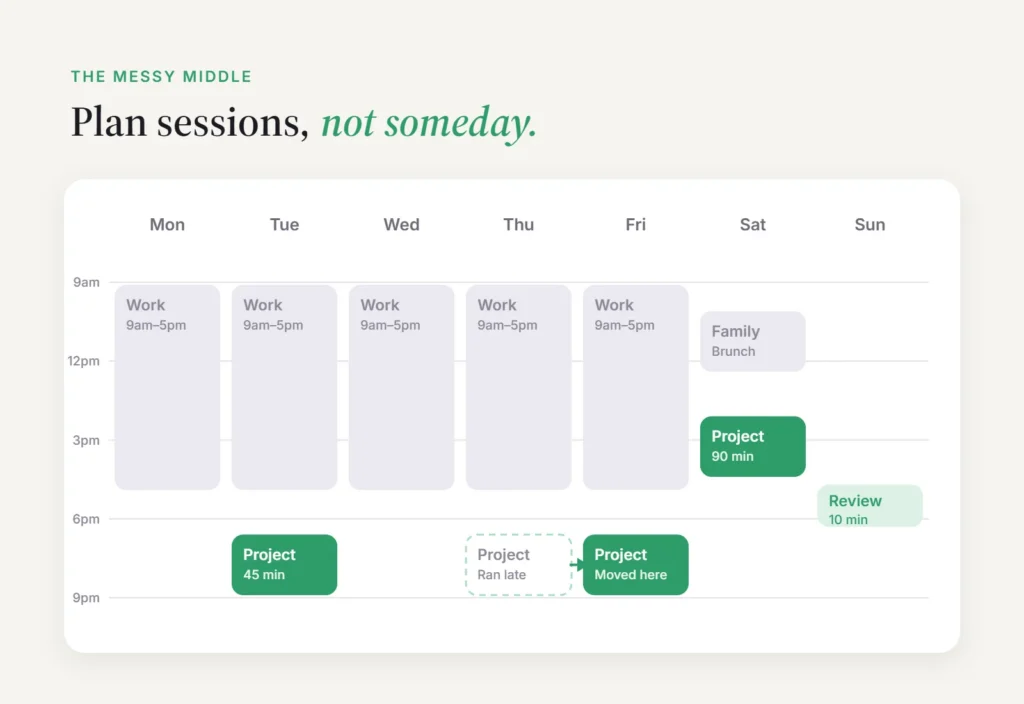
- Decide when and where. Put each session in your daily planner or calendar: “Tuesday, 7pm, at my desk: draft the intro.” Psychologists call this an implementation intention.
- Keep a small, steady rhythm. Two or three 45 min sessions a week beat one heroic weekend you keep postponing.
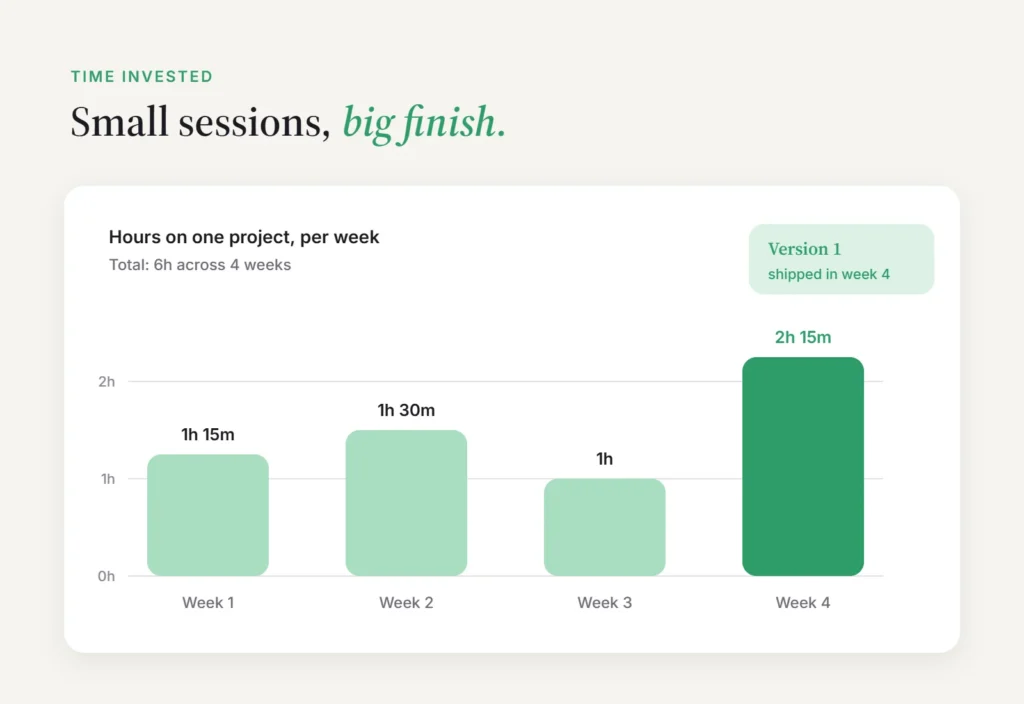
- Make progress visible. Log every session in a goal tracker, habit tracker or plain notebook, even the partial ones. Seeing 6h already invested is a quiet reason to keep going.
That third step matters more than it looks. A review of 94 tests found that when-and-where plans like this had a medium-to-large effect on reaching goals.
The fifth step matters, too. In a study of nearly 12,000 diary entries from 238 employees in seven companies, Harvard Business School researchers found that nothing lifted people’s mood and motivation at work more than making progress in meaningful work. For example, one finished 45 min session counts.
Strict time blocking tends to break the first time a session slips. So when one does, don’t cancel it. Move it to your next free gap. It’s the same idea behind a flexible schedule: keep the time you planned, and let the timing bend. A project only dies when it stops showing up in your week.
Run fewer unfinished projects at once
Every open project takes a little attention, even when you’re not working on it. In fact, ten half-done projects can feel heavier than one big one. It’s far easier to finish what you start when only a few things are started.
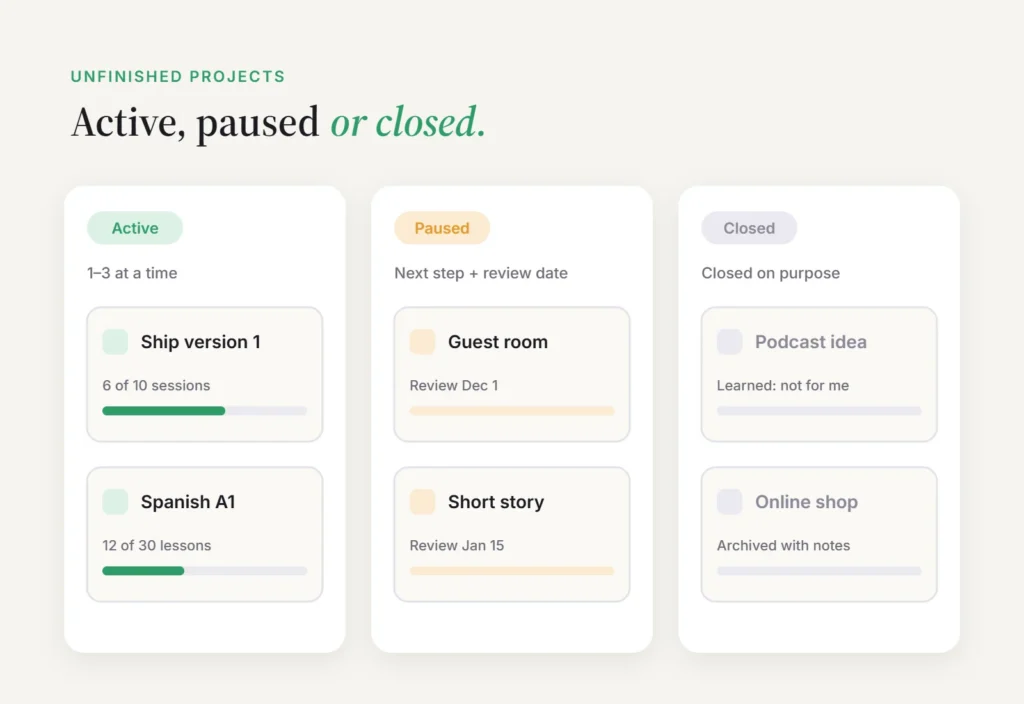
Once a month, sort your unfinished projects into three groups:
- Active: you’ll work on it this week. Keep this to 1–3 projects.
- Paused: it still matters, just not now. Write down the next step and a date to look at it again.
- Closed: it no longer fits your goals. Let it go on purpose.
New ideas go on a simple “later” list until an active project is done or paused. Writing an idea down keeps the excitement without splitting your time.
Not sure which project to keep active? Pick the one that’s closest to done. A quick finish rebuilds trust in yourself, and that trust makes the next project much easier to see through.
Quitting on purpose isn’t failing
Learning how to finish projects also means learning which ones to stop. Sometimes you start something and find out it isn’t for you. That’s useful information, not wasted time.
For example, say you started a podcast and realized you enjoy writing far more than recording. Closing the podcast on purpose, and moving that time to a writing project, is not giving up. It is choosing the project you actually want to finish.
In other words, the difference is intent. Drifting away leaves a quiet sense of guilt. Closing a project leaves a clear head. When you close one, write two lines: what you learned, and what you’d do differently next time. Then archive it and stop carrying it.
A project you close on purpose is finished, too.
Follow through on the few projects that matter most, and you’ll finish what you start far more often than you used to.
How to finish projects with a 4-week plan
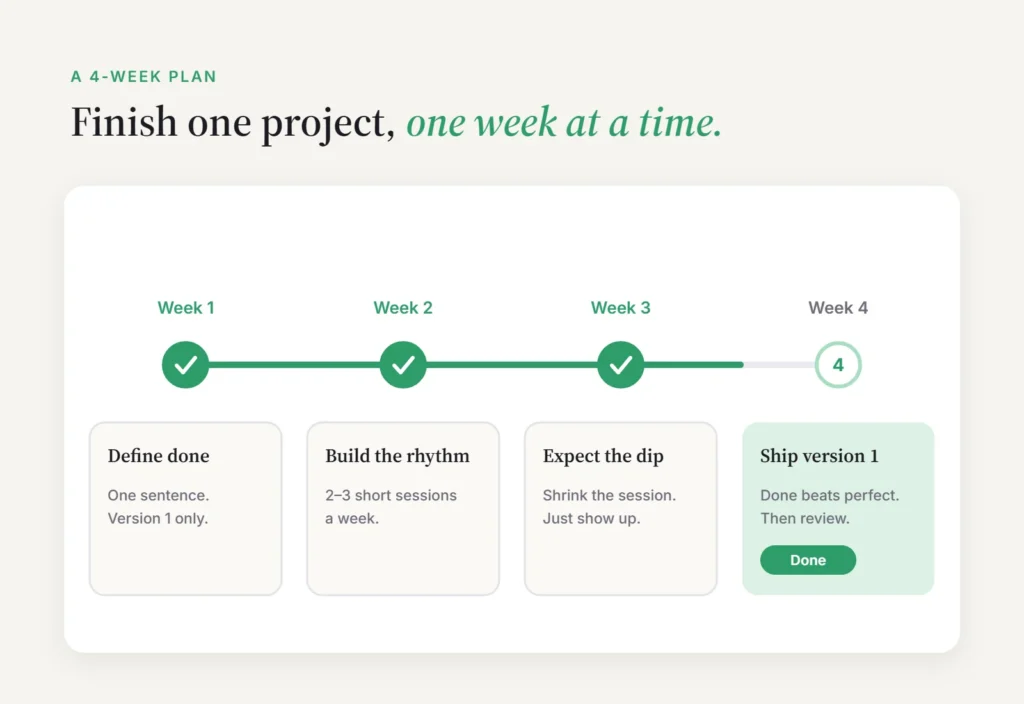
Want a concrete place to begin? Try this 4-week plan on one project. It works for a side project, an online course or a home project, and it fits around a full-time job.
- Week 1: Define done. Write your one-sentence finish line, cut it down to version 1, and list the sessions it will take. Then schedule the first three.
- Week 2: Build the rhythm. Do two or three sessions at roughly the same times. Keep them short enough that skipping one would feel silly.
- Week 3: Expect the dip. This is often when the excitement fades. Instead of pushing harder, shrink the next session to 25 min and simply show up.
- Week 4: Ship version 1. Finish the smallest version that counts, even if it isn’t perfect. Then take 10 min to note what worked.
After that, decide what comes next. You can start version 2, pause the project, or close it on purpose. Either way, you finished something, and that changes how the next project feels.
Meanwhile, keep new ideas on your “later” list. As a result, your attention stays on one finish line at a time. That focus, more than motivation, is how to finish projects you care about.
How Thrive helps you see projects through
Thrive is a free schedule planner for iPhone and Android, built for the long middle. Create an Area of life for what matters, such as Startup or University, set a goal inside it, and plan it into your week with one tap.
Each session becomes a flexible section with a planned duration. If your day runs late, it moves forward automatically instead of quietly disappearing. Meanwhile, you can use the built-in focus timer while you work, or log progress afterwards with a one-swipe progress slider.
Live insights point out free time you could use, and Stats show your Planning vs. Execution and how much time each Area of life gets. Week by week, you can watch your project move forward, one steady session at a time. It’s a calmer way to finish what you start, and to turn unfinished projects into finished ones.
So if you tend to start projects but never finish them, begin small this week: one project, one clear finish line and one session in your calendar. That is how to finish projects without relying on willpower.
FAQs
Why do I start projects but never finish them?
Usually because the excitement of starting fades before the work gets rewarding, and the middle has no clear next step or finish line. When you start projects but never finish them, it's a planning problem far more often than a character flaw.
Is never finishing projects a sign of ADHD?
It can be one of many signs, but on its own it doesn't mean you have ADHD. Plenty of people struggle with follow-through. If it has affected your work, studies or relationships for a long time, a doctor or psychologist can help you understand what's going on.
How do I stay motivated to finish a project?
Don't rely on motivation alone. Schedule short, specific sessions, decide in advance when and where you'll work, and make progress visible. Motivation tends to follow progress, not the other way around.
Is it okay to quit a project instead of finishing it?
Yes, if you decide on purpose. Closing unfinished projects that no longer fit your goals frees time and attention for the ones that do. Write down what you learned, then archive it so it stops nagging you.