On this page
You sat down to check one thing about a new hobby. Suddenly it’s 2 a.m., you skipped dinner, and you feel great. That’s hyperfocus: a deep, absorbed state where the rest of the world fades out.
Then Monday comes, and you can’t focus on a 10 min email. The contrast can make you feel broken, and it confuses the people around you. However, it isn’t really a contradiction. Both come from the same attention, and it follows interest more than importance. Once you see that, you can start steering it.
What hyperfocus is, and why it feels like a contradiction
There’s no single agreed definition yet. A review by Ashinoff and Abu-Akel notes that researchers still describe it in different ways. Still, the reports they gathered share a few features: intense concentration, tuning out everything unrelated, better performance while it lasts, and a task that feels fun or interesting.
That last point explains the puzzle. Your focus isn’t missing. Instead, it’s waiting for fuel. For many people, that fuel is interest, novelty or a close deadline. A boring task has none of these, so attention drifts away, even when the task matters.
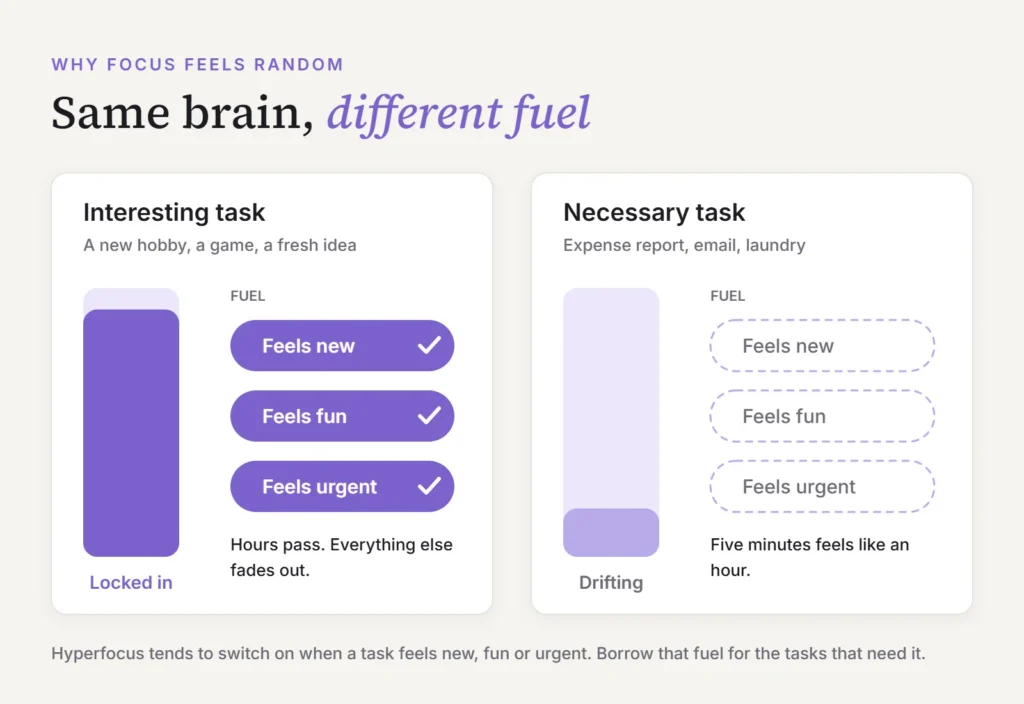
For example, the pattern often looks like this:
- Focus shows up when it wants. You can’t predict which days will be sharp and which will be foggy.
- Interesting work wins. A side project gets 4h while the deadline gets 4 min.
- Time disappears. You look up, and lunch, texts and plans have all slipped by.
- Others see inconsistency. “You did that so well, so why not this?” is hard to answer.
This state also hides time well, which is why it often travels with time blindness. You’re not ignoring the clock on purpose. You just stop noticing it.
It also explains why other people get confused. They saw you work brilliantly for 6h last week, so they assume you chose not to today. In reality, the switch flipped on its own. Knowing that won’t fix everything. However, it can replace “What’s wrong with me?” with a more useful question: “What would make this task interesting enough to start?”
Hyperfocus and ADHD: what the research shows
Hyperfocus ADHD stories are common online, and research backs part of them up. In a 2019 study by Hupfeld, Abagis and Shah, researchers built a questionnaire about these deep-focus episodes. They tested it in two groups of adults with or without ADHD: a pilot sample of 251 people and a replication sample of 372.
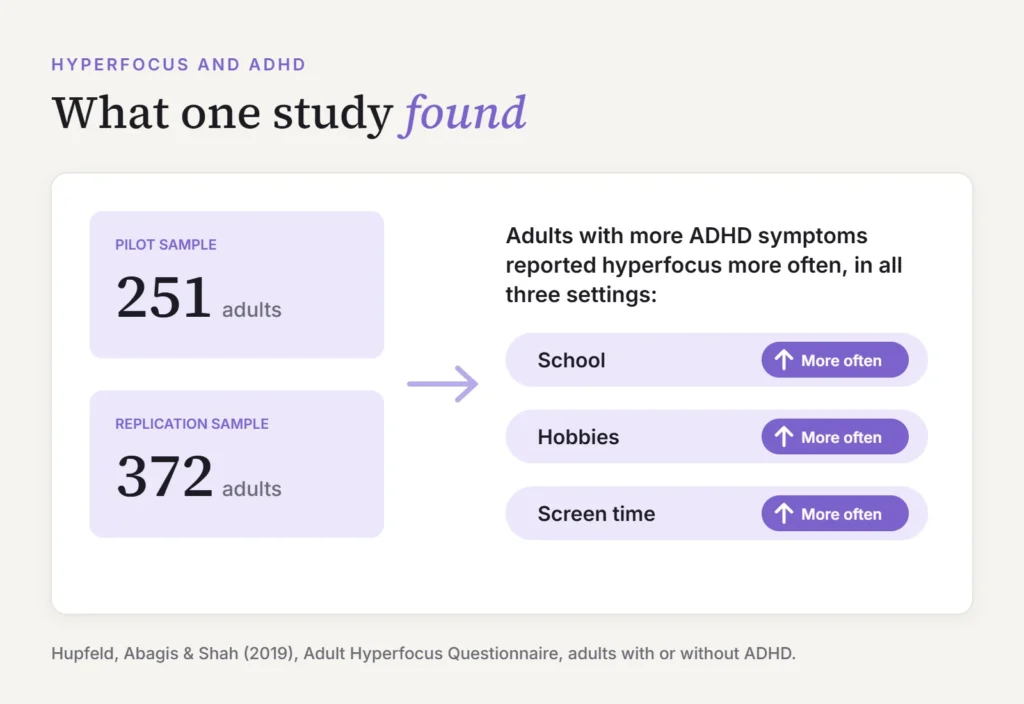
In both groups, people with more ADHD symptoms reported hyperfocus more often. That held at school, in hobbies and during screen time. In other words, deep focus and distractibility can live in the same person. The difference is what switches it on.
However, it isn’t an ADHD test. The same review notes that it’s also discussed in autism, and that most people likely feel something like it now and then. If focus problems get in the way of work, school or relationships, talk to a doctor or psychologist. NIMH has a clear overview of ADHD if you want to learn more.
Your focus isn’t broken. It’s picky.
Why you can’t focus on the tasks that matter
If you can’t focus on an important task, it usually isn’t about willpower. The task simply doesn’t feel interesting, new or urgent yet. So your brain keeps scanning for something that does.
For example, at work it might be the quarterly report that waits while you redesign a slide deck. At school, it’s the reading you skip while you research a random topic for 3h. Meanwhile, at home, it’s the bills that sit unopened while you reorganize a closet. In each case, you did focus hard. You just focused on something else.
Meanwhile, the stakes make it worse. A dull task that matters also carries pressure, and pressure without interest often turns into procrastination. As a result, you scroll, tidy or start something shiny instead. That’s the same stuck feeling behind executive dysfunction, and it responds to the same gentle approach: make starting smaller and more appealing.
On the other side, deep focus has a cost, too. It can swallow meals, sleep and plans you made with other people. So the goal isn’t to get rid of it. Instead, it’s to point it, and to give it an exit.
7 ways to aim your hyperfocus on purpose
You don’t need all seven. Pick one for boring tasks and one for long dives, and start there.
- Add one spark to dull tasks. Make the task new, social or timed. For example, answer emails in a cafe, or race a 20 min timer.
- Pair it with something you like. Save a favorite playlist or podcast for the task you keep avoiding.
- Start inside the interesting part. Begin a report with the chart you enjoy making, not the intro you dread.
- Set your exit before you dive in. Decide your stop time, and set an alarm across the room before you start.
- Use if-then plans. “If the alarm rings, then I stand up and drink water.” A plan made in advance is easier to follow mid-flow.
- Leave a note for future you. Before you stop, write one line about your next step. Then stopping doesn’t feel like losing the thread.
- Book your best hours. Put the important task where your focus is usually strongest, and protect that block.
If-then plans have solid backing. Across 94 tests, Gollwitzer and Sheeran (2006) found a medium-to-large effect on reaching goals. Meanwhile, the note-to-self trick also eases your working memory, because the plan no longer has to live in your head.
Notice that half of these tips make dull tasks more appealing, and half make deep dives easier to leave. You need both. A spark without an exit can trade one problem for another. However, an exit without a spark leaves you staring at the task you were dodging.
How to hyperfocus on purpose with a 5-day plan
You can’t force deep focus. However, you can set up the conditions that make it more likely, and add a few guardrails. So try one change a day.
- Day 1: Notice. Each time you lock in, jot down what you were doing and why it grabbed you. A notebook or daily planner is enough.
- Day 2: Exit plan. Before any long session, set a stop time and an alarm. Plan a small landing task, like a glass of water.
- Day 3: Add a spark. Take one dull task and make it feel new, fun or urgent, using a tip from the list above.
- Day 4: Focus sprint. Run one 25 min focus timer, pomodoro style, on a single important task. Close everything else.
- Day 5: Review. Spend 10 min looking back. What switched your focus on? Keep the change that helped most.
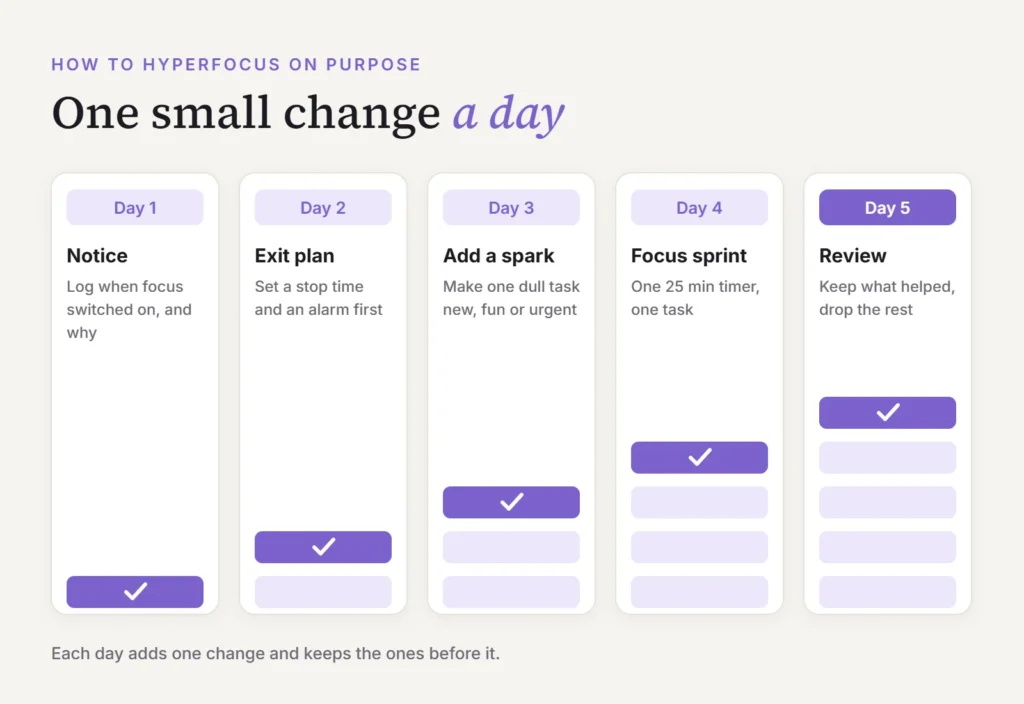
Missed a day? That’s fine. Falling behind isn’t failure. It’s information. Pick up where you left off, and keep the changes that work for you.
After a week, you’ll know your own triggers better than any list. For example, you might learn that deadlines spark you but noisy rooms don’t, or that mornings work and evenings never do. That’s useful data for planning your next week.
How Thrive helps you steer your focus
Thrive is a free schedule planner for iPhone and Android. It won’t switch hyperfocus on for you. However, it makes it easier to aim your focus, and to recover when a session runs long.
- A live schedule that bends. Fixed blocks hold meetings and classes. Flexible sections have a planned duration and move forward automatically when you fall behind. So one long session doesn’t wreck the rest of the day. It’s a flexible schedule that updates itself.
- A focus timer for one task. Start the timer on a section and work on just that. Forgot to start it? Log your progress afterward with the one-swipe progress slider.
- Live insights that keep you honest. “Can’t finish plans today” tells you when the day no longer fits, and “Over Planning” flags days packed beyond your capacity.
- Stats by Area of life. See where your time actually went, for example Work vs. a side project, and how your plan compared with what you did.
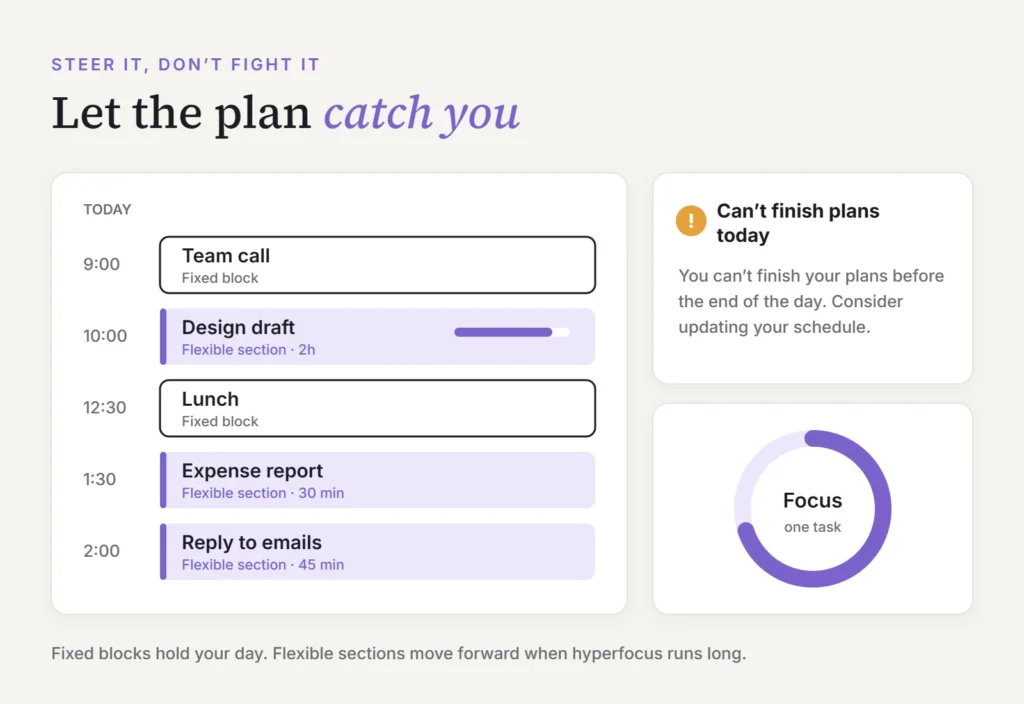
For example, say your design draft runs an hour over. You don’t have to rebuild the afternoon by hand. Your flexible sections move forward, and the insights show what still fits. Meanwhile, over time, your stats show where your focus tends to go.
Over a few weeks, that view can be eye-opening. For example, you might find that a side project gets most of your evening focus, while your top work goal only gets leftovers. That’s not a reason for guilt. Instead, it’s a cue to move the important block into your best hours.
Hyperfocus isn’t a flaw to fix. It’s strong attention that follows interest. So give dull tasks a spark, give deep dives an exit, and let your plan absorb the rest. That’s how to hyperfocus on purpose, and how to cope on the days you can’t focus at all.
FAQs
What is hyperfocus?
It's a state of deep absorption in an interesting task, where everything else seems to fade out. There's no single agreed scientific definition yet, and many people without ADHD feel it now and then.
Is hyperfocus a sign of ADHD?
Not on its own. Hyperfocus ADHD research links more ADHD symptoms with more frequent hyperfocus, but plenty of people experience it. If focus problems disrupt work, school or relationships, talk to a doctor or psychologist.
Why can I focus for hours on games but can't focus on work?
Deep focus tends to switch on for tasks that feel fun, new or urgent. When a task has none of those, attention drifts, so you can't focus on it even when it matters.
How do I stop hyperfocus from taking over my day?
Decide your stop time before you start, set an alarm across the room and plan a small landing task. That's also the safest way to learn how to hyperfocus on purpose.