
On this page
You glance at the clock and it’s 2:10. You answer one message, and suddenly it’s 2:55, even though you meant to leave at 2:30. If that happens a lot, you may be dealing with time blindness: trouble sensing how much time has passed and how long a task will take.
It’s frustrating, and it can make you look careless when you’re not. The good news is that you don’t have to feel time better to manage it. You can make time visible instead. In this guide, you’ll learn what it is, why you’re always late even when you try, and a 2-week plan for how to estimate time.
What time blindness is, and what it isn’t
Time blindness isn’t a medical diagnosis. It’s an everyday name for a weak inner sense of time. Minutes slip by unnoticed, and future deadlines feel unreal until they’re suddenly close.
For example, it often looks like this:
- Time vanishes during interesting work. You look up and an hour has gone.
- Boring tasks feel endless. Ten minutes of paperwork can feel like an hour.
- Estimates miss in both directions. A “quick” errand takes 90 min, while a dreaded phone call takes 5.
- “Later” has no shape. A deadline next Friday feels the same as one next month, until it doesn’t.
However, it isn’t the same as not caring. Many people who struggle with it care a lot about being on time. They just can’t feel the clock the way other people seem to.
It also helps to know that there are two sides to it. One is the present: noticing that 40 min have passed. The other is the future: sensing how far away 3pm, or next Friday, really is. Most of the fixes below work on one side or the other.
You don’t need to feel time. You need to see it.
Time blindness and ADHD: what research shows
People often search for time blindness ADHD links, and research does support a connection. A meta-analysis of 27 studies, with 1,620 children and teens with ADHD and 1,249 without, found that the ADHD group judged time less accurately and less precisely. They were also more likely to overestimate time intervals.
That research looked at young people, though, and lab tasks aren’t real life. Trouble with time can also show up with anxiety, depression, burnout, poor sleep or plain overload. So a struggle with time doesn’t mean you have ADHD.
If you’re reading about time blindness ADHD links for yourself, the practical lesson is the same either way. Don’t rely on how time feels. Rely on what you can see and measure, like the tools below.
A note on health. This article isn’t medical advice. If time problems have affected your work, studies or relationships for a long time, a doctor or psychologist can help you understand why. The NIMH overview of ADHD is a good place to start reading.
Why you’re always late, even when you try
Being always late is rarely about one big mistake. It’s usually a stack of small, invisible minutes, and it isn’t a character flaw or a time management failure.
First, almost everyone underestimates. In a classic study of the planning fallacy, students predicted they’d finish their thesis in 33.9 days on average. In reality, they took 55.5 days, and only 29.7% finished by the time they had predicted. In other words, optimistic guesses are normal. When your sense of time is weak, that gap is just easier to fall into.
Second, we plan the task but forget its edges:
- Transitions. Saving your work, finding your keys, putting on shoes.
- Travel extras. Parking, elevators and the walk from the car.
- Last-minute tasks. “Just one email” before you go.
- Settling in. Getting back into focus after an interruption.
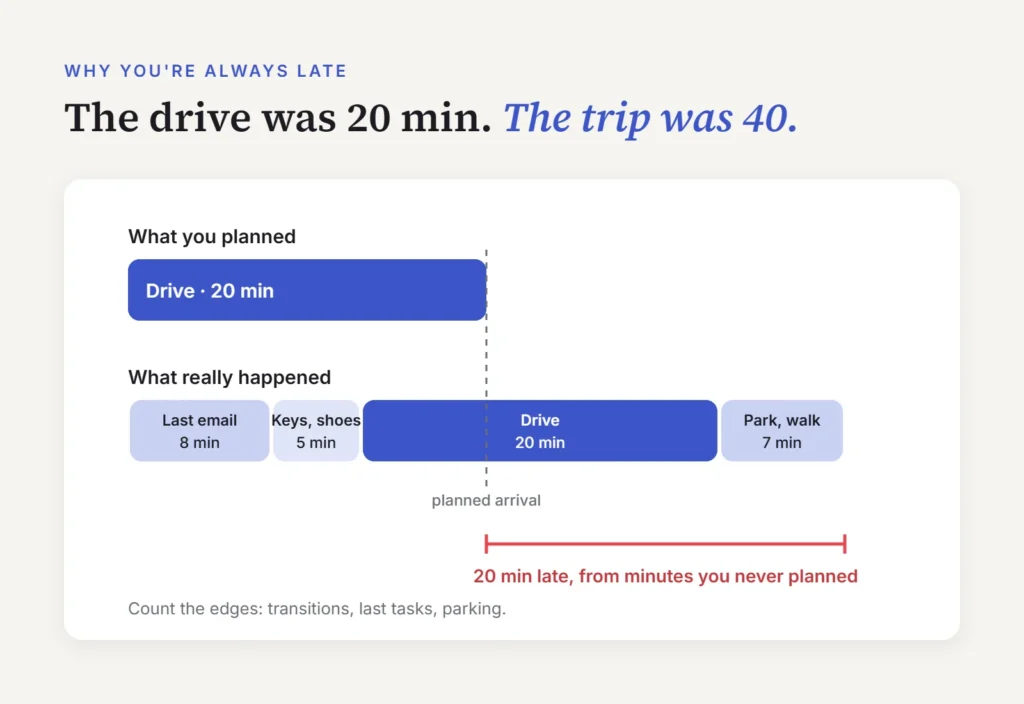
Each edge feels like nothing. Together, they quietly turn an on-time plan into a late arrival. So the fix isn’t trying harder. It’s counting the edges and making time visible.
When someone is waiting for you. If you can already see you’ll be late, say so early and give a real new time. A short, honest message protects trust far better than a last-minute apology. Then, next time, add that missing edge to your plan.
7 ways to manage time blindness every day
You can’t install an inner clock. However, you can put one outside your head. Pick two or three of these to start, not all seven:
- Use a clock you can see. An analog clock or a visual timer shows time as a shrinking space, which is easier to feel than a number.
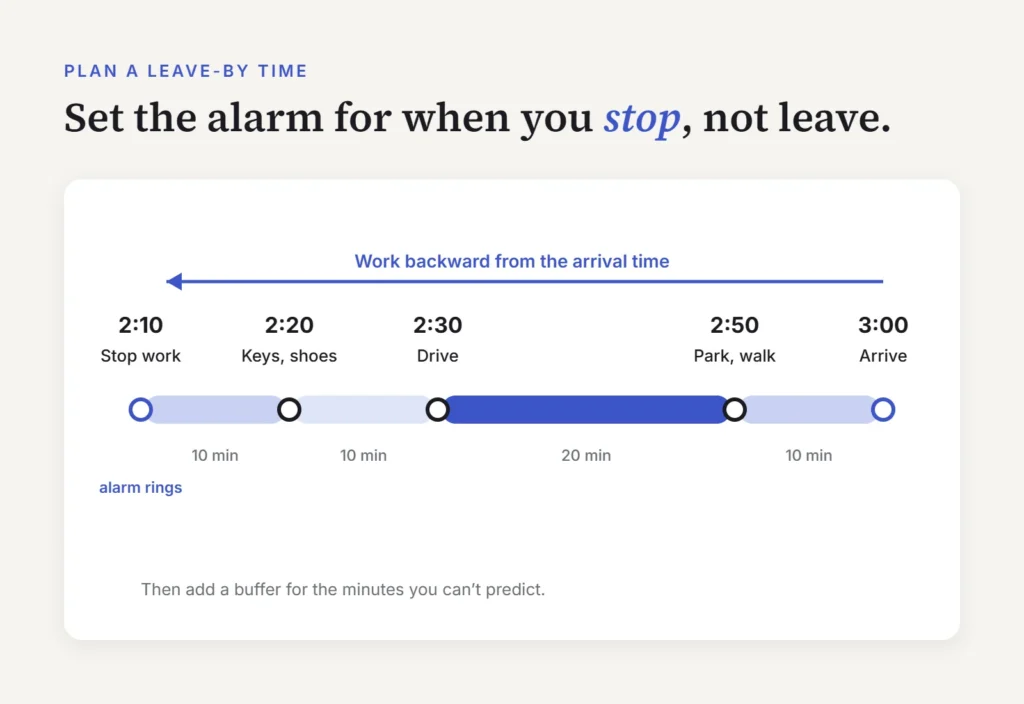
- Plan a leave-by time. Work backward from when you must arrive. Then set an alarm for when you must stop working, not when you must leave.
- Add a buffer. Pad each estimate by about a third until your own data gives you a better number.
- Say the time out loud. “It’s 2:15, so I have 15 min left.” Naming it helps time feel real.
- Set a halfway check-in. For a 1h task, a quiet alert at 30 min shows whether you’re on track.
- Leave gaps between plans. A 15 min gap after each meeting soaks up overruns.
- Prepare exits the night before. Keys, bag and shoes in one spot means fewer surprise minutes.
If you’re always late, start with the second and third moves. A leave-by time turns the hidden edges into part of the plan, and a buffer catches whatever is left.
When the deadline is far away. Distant deadlines are the other half of the problem. So turn them into near ones: split the work into dated checkpoints, and put the first one within the next 2–3 days. A deadline you can see this week is much easier to feel than one at the end of the month.
When you hyperfocus. Interesting work is where time blindness hides best. So set the alarm before you start, put your phone across the room, and decide now what you’ll do when it rings.
How to estimate time better with a 2-week plan
Learning how to estimate time is a skill. It’s built on your own evidence, not on hopeful guesses, and this plan takes only a few minutes a day.
- Days 1–3: Guess, then measure. For 3–5 tasks a day, write your estimate first. Then time the task with a focus timer or a simple time tracker.
- Days 4–7: Find your ratio. Divide the actual time by your guess. If a 20 min guess took 30 min, your ratio is 1.5.
- Days 8–10: Apply it. Multiply new estimates by your ratio before you put them in your daily planner.
- Days 11–14: Sort by task type. Note which tasks, such as email, cleaning or writing, need the biggest buffer.
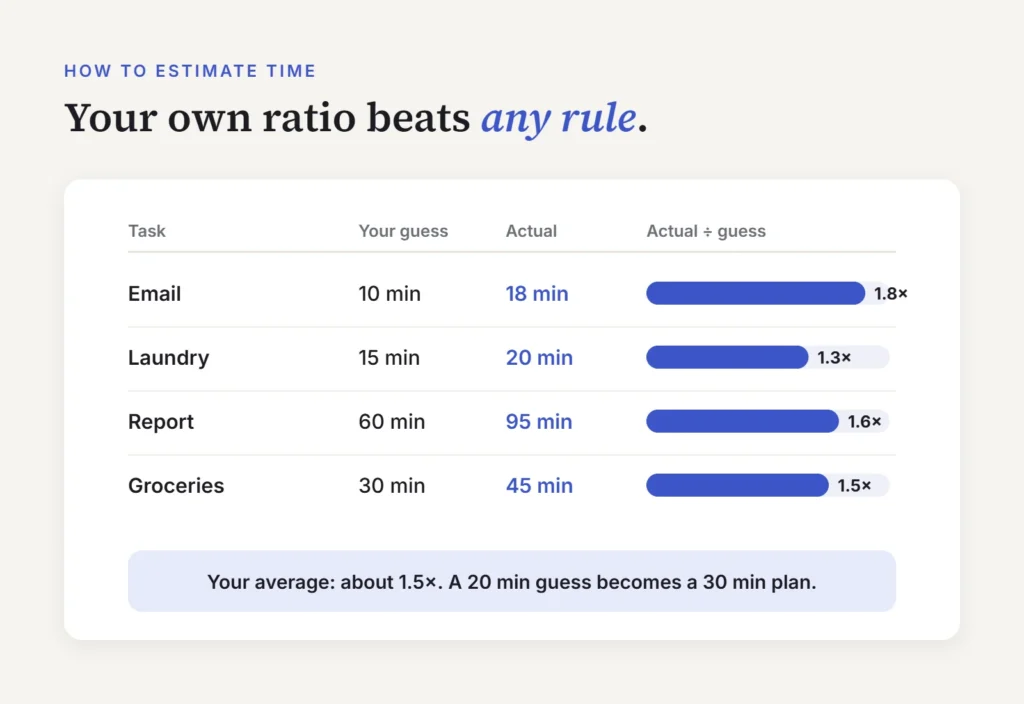
As a result, you’ll have personal numbers instead of hopeful ones. Your ratio may change by task type, and that’s useful information, not a flaw.
Estimate in ranges, not single numbers. Instead of “20 min,” say “20 to 30 min,” then plan for the top of the range. A range feels less like a promise, so a slow day doesn’t feel like failure. As your log grows, your ranges will get tighter.
Keep the log tiny. A note on your phone with three columns is plenty: task, guess, actual. If logging takes more than a minute, you’ll stop doing it, so keep it that simple.
A wrong estimate isn’t failure. It’s data.
Also, if starting is harder for you than timing, our guide to executive dysfunction and task paralysis has small ways to begin. And if you start strong but stall halfway, see how to finish what you start.
How Thrive helps with time blindness
Thrive is a free schedule planner for iPhone and Android. It shows your day as it really is, not as you planned it at 8am.
Add appointments as fixed blocks with a set start and end time. Then add tasks as flexible sections with a planned duration. When one task runs long, the flexible sections after it move forward automatically, so your timeline keeps showing what still fits. That’s the idea behind a flexible schedule that survives a real day.
Meanwhile, the built-in focus timer records how long a section really took. If you forget the timer, log your progress afterward with the one-swipe progress slider. Live insights cover the blind spots, too: “Free time today” shows how much time is left, and “Can’t finish plans today” warns you early when the day no longer fits.
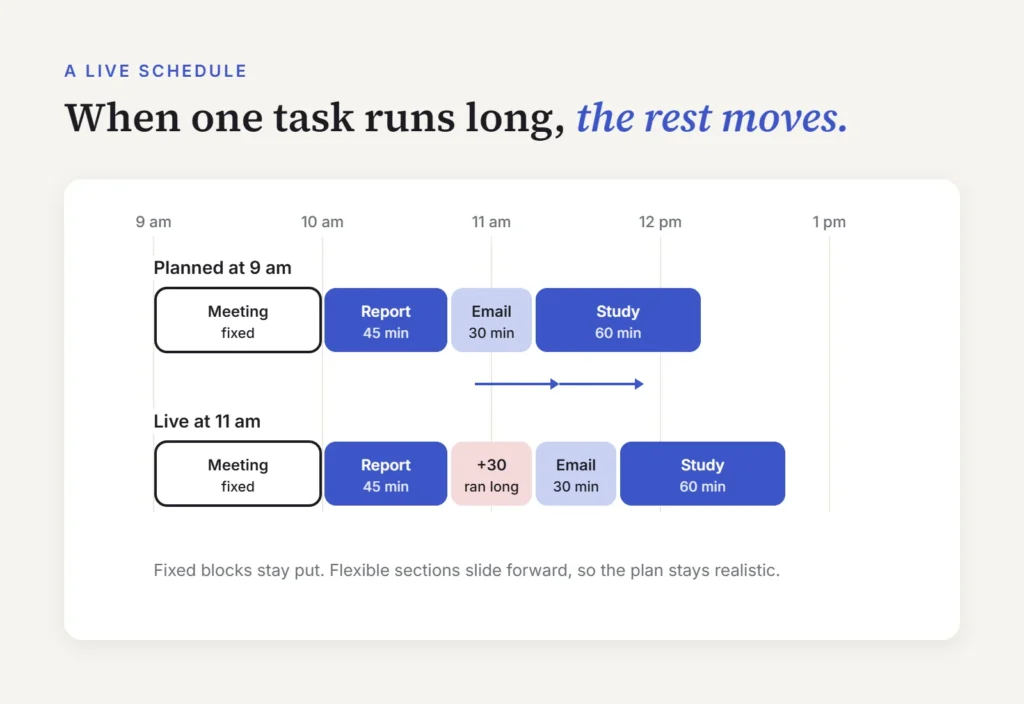
Over time, Stats compare your Planning vs. Execution. That works like an estimate log you don’t have to keep by hand.
Time blindness can make you feel always late and always behind. But you don’t need a better inner clock. Make time visible, count the edges, and learn how to estimate time from your own numbers. Start with one leave-by alarm today.
FAQs
Is time blindness a real thing?
Time blindness isn't a formal diagnosis, but trouble sensing and estimating time is well documented, especially with ADHD. It describes a real struggle, not a character flaw.
Is time blindness an ADHD symptom?
Time blindness ADHD links are common, and studies find that people with ADHD judge time less accurately on average. It can also come with anxiety, burnout or poor sleep, so talk to a doctor if it affects your daily life.
How do I stop being always late?
Work backward from your arrival time to set a leave-by alarm, and pad your plan for edges like keys, parking and last emails. Being always late usually comes from small hidden minutes, not one big mistake.
How can I estimate time more accurately?
Write a guess before each task, then time it. After a week, divide actual time by guessed time and use that ratio on new estimates. That's how to estimate time from your own data.