On this page
You know exactly what needs doing. The email is short and the form takes 10 min, yet you sit there, frozen. If that sounds familiar, you may be dealing with executive dysfunction, and it is not the same as being lazy.
Starting is a skill your brain runs in the background. When that skill stalls, pushing harder rarely helps. Smaller, clearer and kinder starts usually do. In this guide, you’ll learn why task paralysis happens, seven small ways to start, and a 5-day plan to practice task initiation.
What executive dysfunction feels like day to day
Executive functions are the mental skills that help you plan, focus, hold instructions in mind and switch between tasks. Getting started, often called task initiation, is one of them.
When those skills misfire, the gap between knowing and doing gets wide. For example:
- You can describe the task but can’t begin it. The plan is clear in your head, yet nothing happens.
- Small jobs feel oddly heavy. Replying to one email can take more energy than an afternoon of interesting work.
- Waiting turns into stress. The longer a task sits, the bigger it feels, and missed deadlines start to pile up.
- Other people see “lazy”. From the outside, being stuck can look like not caring, which only adds shame.
This is different from everyday procrastination, although the two overlap. With ordinary procrastination, you usually pick something more fun instead. With executive dysfunction, the waiting often isn’t fun at all. You may sit in front of the task for an hour, doing nothing and feeling worse by the minute.
A note on health. Executive dysfunction is often linked to ADHD, and it can also show up with anxiety, depression, burnout or poor sleep. It isn’t a diagnosis on its own, and this article isn’t medical advice. If being stuck has affected your work, studies or relationships for a long time, a doctor or psychologist can help you understand what’s behind it.
Why task paralysis happens, even when you care
Task paralysis is the frozen feeling right before you start. It’s rarely about the task itself. Usually, it’s about what the task asks of you.
A large review of procrastination research, based on 691 correlations, found that some of the strongest and most consistent predictors of putting things off were how unpleasant a task feels, how long it takes to pay off, how confident people feel they can do it, and impulsiveness. Distractibility mattered, too.
In everyday terms, four things tend to freeze a start:
- The first step is fuzzy. “Do taxes” isn’t an action. Your brain can’t start something it can’t picture.
- The task brings up a feeling. Boredom, fear of getting it wrong, or dread of a hard conversation. Avoiding the task is often avoiding that feeling.
- There are too many options. A long to-do list makes every item compete, so none of them wins.
- There’s no start time. “Later today” never quite arrives, because nothing marks the moment to begin.
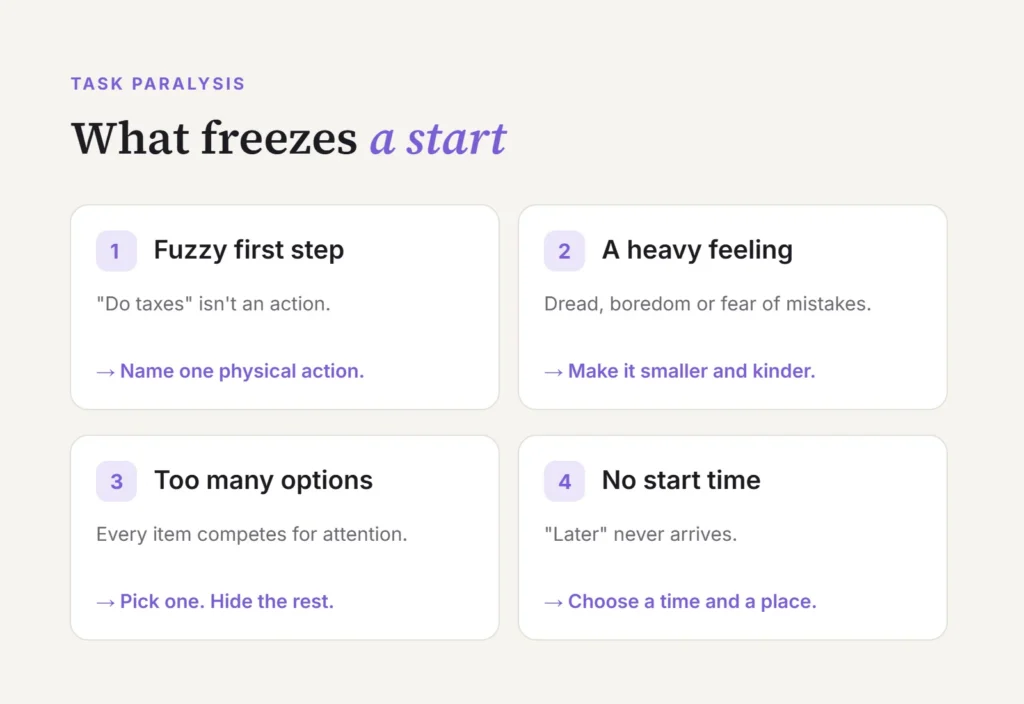
None of these is a moral failing. They’re friction, and friction can be reduced.
Stress makes it worse, too. Missed deadlines and mounting pressure can make the next start feel even riskier, which is why task paralysis often snowballs. The good news is that the loop also works in reverse: one small start makes the next one a little easier.
How to start a task when executive dysfunction hits
You don’t need to feel ready. You only need a start that’s too small to resist. So, pick one or two of these moves, not all seven:
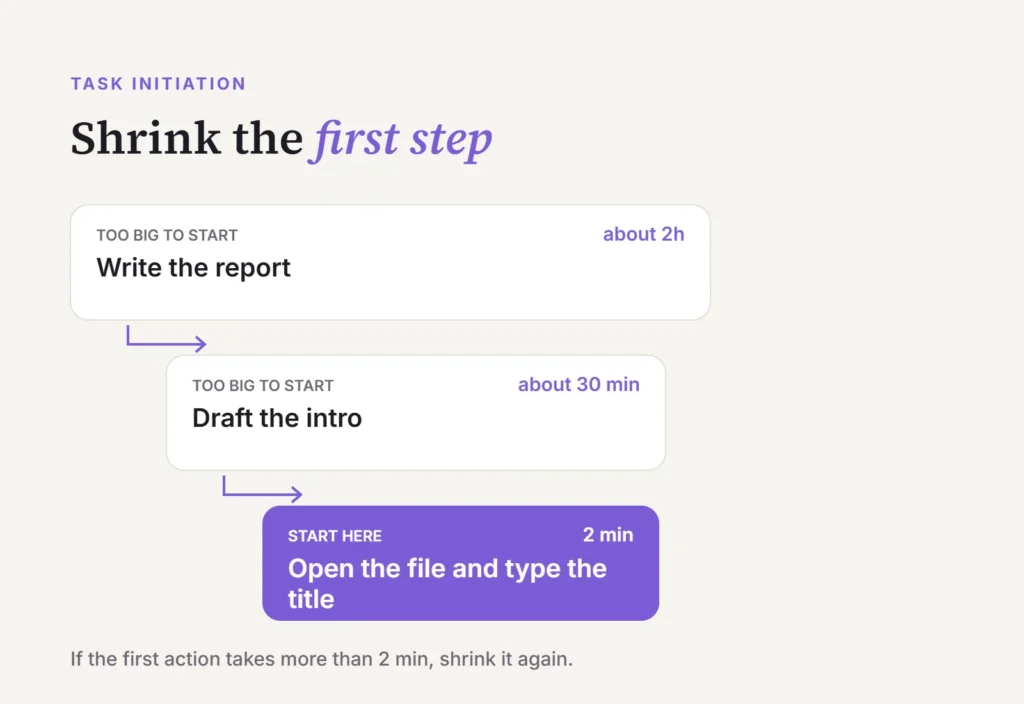
- Name the very first action. Not “write the report” but “open the file and type the title.” If it takes more than 2 min, shrink it again.
- Set a 5 min timer. Promise yourself only 5 min, and mean it. Stopping after 5 min still counts as starting.
- Lower the quality bar. Give yourself permission to make a rough first pass. You can’t edit a blank page.
- Prepare the space first. Clear the desk, open the right tab and put your phone in another room before you sit down.
- Pick a start time and place. “At 2pm, at the kitchen table, I’ll open the form.” A clear cue does some of the deciding for you.
- Work next to someone. A friend on a video call or a quiet library can make starting feel less lonely.
- Pair it with something pleasant. Good music or a favorite drink can take the edge off a dull task.
The fifth move has solid research behind it. A review of 94 tests found that simple when-and-where plans had a medium-to-large effect on reaching goals. In other words, deciding when you’ll begin is part of how to start a task, not an extra step.
Once you’re moving, keep the next step visible. Momentum is much easier to keep than to create.
When everything feels urgent. If several tasks are frozen at once, don’t try to sort the whole to-do list. Pick the one with the nearest real deadline, or the one that would bring the most relief once it’s moving. Then start that one, and only that one, for 5 min.
Lower the pressure, not your standards
Executive dysfunction often comes with a loud inner critic. However, shame doesn’t make starting easier. It just adds one more heavy feeling to avoid.
Try swapping the script:
- Instead of “I’m so lazy,” try “This task feels heavy right now, so I’ll make it smaller.”
- Instead of “I should have done this days ago,” try “The best time to start is the next 5 min.”
- Instead of “I have to finish it today,” try “Today I’ll just get it moving.”
Stuck isn’t lazy. Stuck is a signal to make the step smaller.
Meanwhile, notice your energy. Many people find starts easier at certain times of day. If mornings feel foggy, for example, put tricky starts in the afternoon and keep mornings for easy wins.
When a deadline is close. Pressure can sometimes help you start, but it usually costs sleep and adds stress. Instead of waiting for panic, borrow a little urgency early. For example, tell someone when you’ll send a first draft, or book a short slot in your calendar and treat it like an appointment.
Also, if you tend to start well and then stall halfway, that’s a different problem. Our guide on how to finish what you start covers the long middle.
How to build task initiation with a 5-day plan
Task initiation gets easier with practice, like any skill. This 5-day plan uses one small start a day, so the habit forms around beginning, not finishing.
- Day 1: Pick one stuck task. Write its very first action in one line. Then do just that action.
- Day 2: Add a start time. Choose a time and place, put it in your daily planner, and run a 5 min focus timer when it comes.
- Day 3: Try 10 min. Same task or a new one. Stop when the timer rings, or keep going if you want to.
- Day 4: Prepare the night before. Lay out what you need, so tomorrow’s start takes one step.
- Day 5: Review what worked. Note which moves helped and which didn’t. Keep the two that worked best.
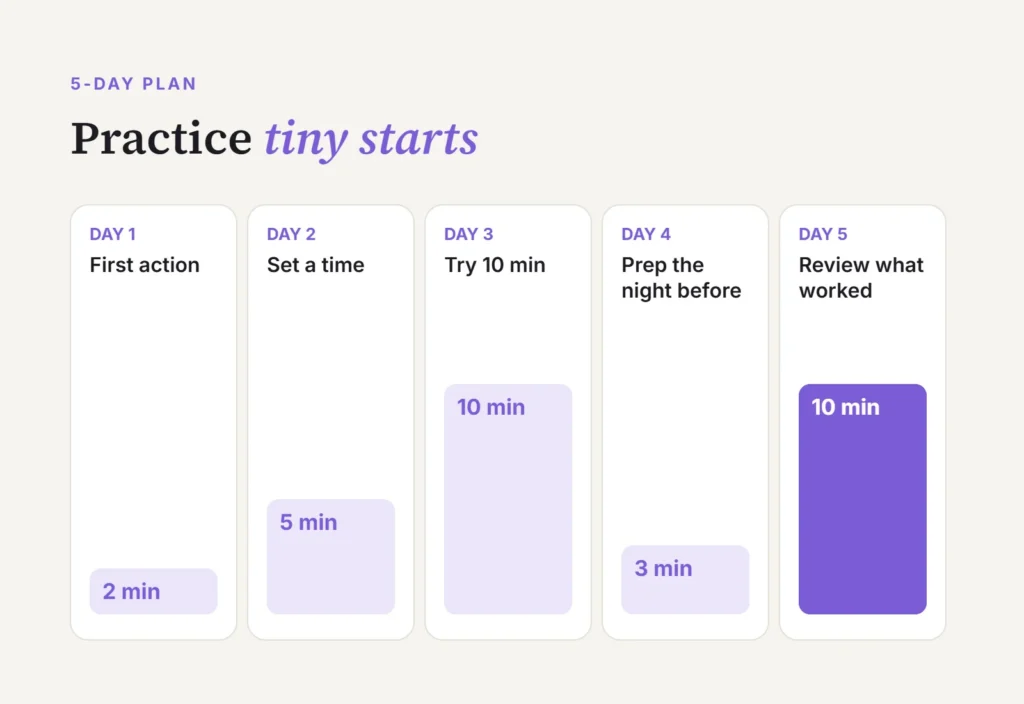
As a result, by the end of the week you’ll have a small, personal starting routine. It won’t make every task easy. But it can make task paralysis shorter and less frequent.
It also helps to keep a tiny log. Write down the task, the move you used and how many minutes you worked, in a notebook or a simple time tracker. After a week, you’ll see which starts work for you, and that evidence is far more convincing than any pep talk.
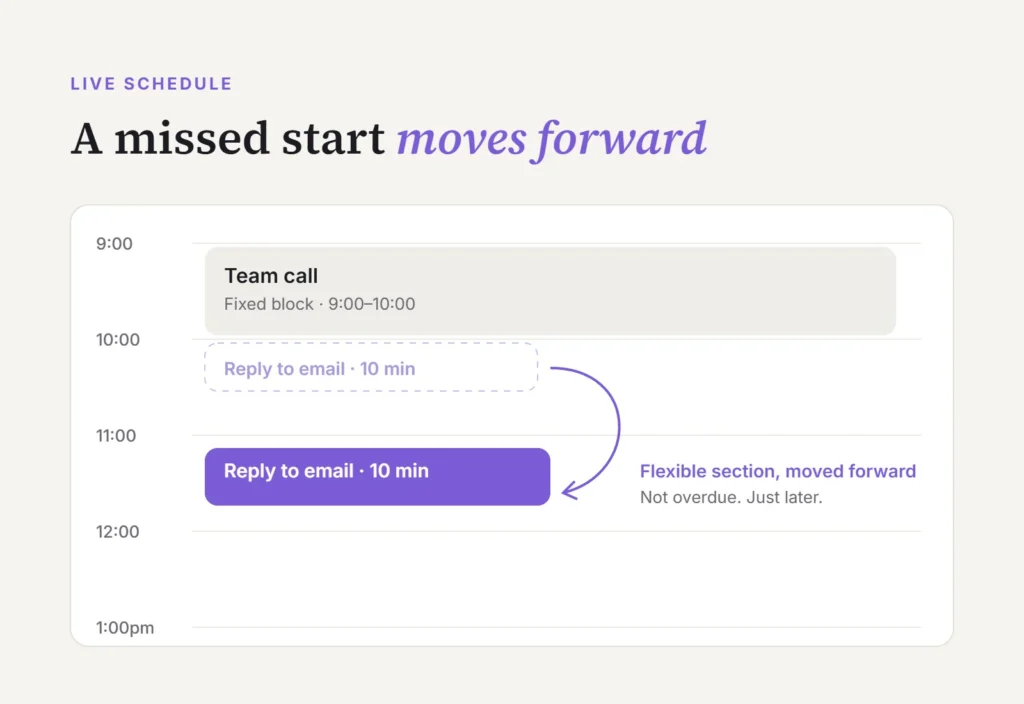
If a day goes badly, don’t restart the plan. Just do the next day. A flexible schedule works the same way: when something slips, it moves forward instead of disappearing.
How Thrive helps when executive dysfunction makes starting hard
Thrive is a free schedule planner for iPhone and Android. It’s built to make the next step obvious, so there’s less to decide when you feel stuck.
Add a stuck task as a flexible section with a short planned duration, like 10 min. If you don’t get to it, it moves forward automatically instead of turning into a red overdue item. When you’re ready, start the built-in focus timer, or log what you did afterwards with a one-swipe progress slider.
Live insights such as “Over Planning” and “Can’t finish plans today” flag a too-full day early, so you can move non-urgent work before overwhelm sets in. Over time, Stats show your Planning vs. Execution, which makes progress visible even on slow weeks.
Executive dysfunction can make the first step feel like the hardest part of the day. So make it smaller, give it a time, and let it count. That’s how to start a task when task paralysis shows up, one small start at a time.
FAQs
Is executive dysfunction the same as being lazy?
No. Laziness means not wanting to do something. With executive dysfunction, you often want to start and still feel stuck, because the skills that turn intention into action aren't cooperating.
What is task paralysis?
Task paralysis is the frozen feeling of knowing what to do but not being able to begin. It often comes from a fuzzy first step, an uncomfortable feeling about the task, or too many options at once.
How do I start a task when I feel frozen?
Shrink the task to one action that takes under 2 min, set a 5 min timer, and decide exactly when and where you'll begin. A tiny start still counts as task initiation.
Does executive dysfunction mean I have ADHD?
Not necessarily. It's often linked to ADHD, but it can also come with anxiety, depression, burnout or poor sleep. If it affects your daily life for a long time, talk to a doctor or psychologist.